
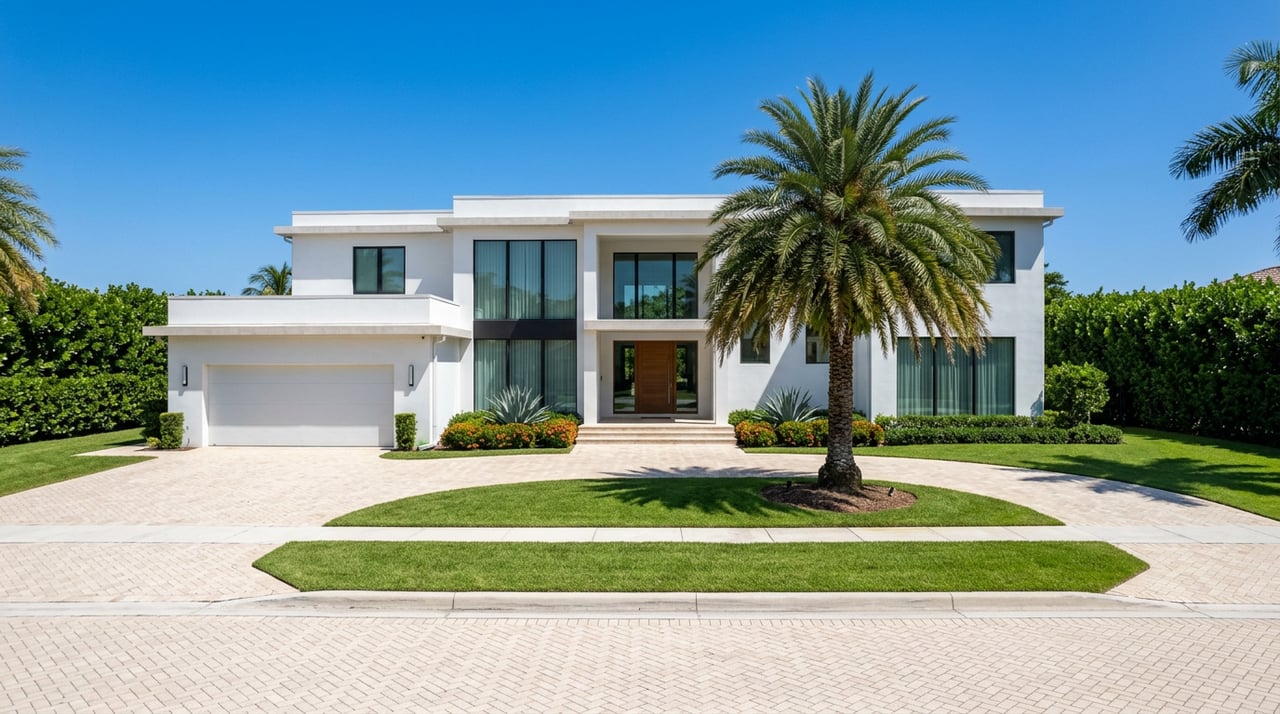
A buyer signing a reservation agreement for a unit at the Ritz-Carlton Residences Palm Beach Gardens or a new build going up along Jupiter's US 1 corridor tends to hear the same reassurance from the sales table: your deposit is escrowed, your money is protected, Florida law has you covered. That statement is true for exactly one slice of the money and false, or at least dangerously incomplete, for the rest.
Florida Statute 718.202 requires a condominium developer to hold payments up to 10 percent of the purchase price in escrow when the building isn't substantially complete. On a $1.1 million unit, that's $110,000 sitting somewhere a court can find it if the project stalls. But most Palm Beach County pre-construction contracts collect far more than 10 percent before closing, typically 30 to 50 percent across staged milestones. The statute allows every dollar above that first 10 percent to be released to the developer for actual construction costs, as long as the contract discloses it in the required bolded language. So on that same $1.1 million unit, if the schedule calls for 10 percent at signing, 10 percent at groundbreaking, and 10 percent at a mid-construction milestone, roughly $220,000 of the buyer's $330,000 isn't sitting in a trust account. It's already framed into the building.
The Money You Assume Is Locked Away Usually Isn't
This is the part that catches people off guard, not because it's hidden but because it's technically disclosed in language nobody reads twice. Once a contract includes the statutory legend permitting construction-use of deposits above 10 percent, the developer is doing exactly what Florida law allows. It isn't a red flag slipped past the buyer's attorney. It's the mechanism working as designed, and the mechanism was designed to give developers working capital, not to give buyers a guarantee.
What changes the buyer's actual exposure is timing. A project that has already topped off and is weeks from a certificate of occupancy carries a different risk profile than one that just opened reservations. The Ritz-Carlton Residences Palm Beach Gardens is a useful marker here. Developed by Catalfumo Companies under Chairman and CEO Daniel Catalfumo, the 106-unit project spans the last 14 contiguous acres of waterfront land at 2200 PGA Boulevard, with Seafood Builders as general contractor and Spina O'Rourke + Partners as architect. By early 2026 all three buildings had topped off, with a completion target of that spring, meaning a buyer who signed there over the past year or two has already moved through most of the window where construction-use deposits carry real forfeiture risk. A buyer reserving into Nautilus 220 in Lake Park, still in its earlier phase of transforming the Intracoastal waterfront into condo towers with a marina and restaurant program, or into the Serhant-led apartment and mixed-use project planned for the US 1 corridor in Jupiter, is standing at a different point on that same curve. More of their deposit dollars are still ahead of them, and more of those dollars will pass through the construction-use door rather than the escrow door.
The Product Type Changes the Rules Entirely
Here's the detail most pre-construction guides skip because they're written for condo towers in Miami and Fort Lauderdale: Chapter 718's deposit escrow requirement applies to condominiums. It does not govern the standard purchase contract for a new single-family home on a platted lot. Palm Beach County's new-construction pipeline is split roughly down the middle between the two. Buyers reserving a spec home in Sonoma Isles, a gated DiVosta-built community in northern Jupiter, or a one-acre estate lot in Bridgewater, or a home site inside the 4,752-acre Avenir development in Palm Beach Gardens, are operating under a different contractual framework entirely, typically a standard Florida residential contract with a builder deposit and construction draw schedule set by the builder rather than by a condominium statute.
That means the protection a buyer assumes applies uniformly across "new construction" in this market actually depends on which box they're buying into. A $2 million single-family reservation in Alton and a $2 million condo reservation on the Intracoastal are not carrying the same statutory guardrails, even though both sales reps will use the word "deposit" as if it means the same thing.
Here's how the two typically compare on a $1 million purchase, using common Florida deposit structures for each product type:
| Stage | Condo (Chapter 718 project) | Single-family / townhome build |
|---|---|---|
| Reservation | Refundable, held until purchase agreement signed | Often refundable or nominal |
| At contract signing | 10% into statutory escrow | Deposit set by builder contract, no Chapter 718 escrow requirement |
| Groundbreaking / permit issuance | Additional 10%, may be construction-use if disclosed | Draw schedule tied to builder's own contract terms |
| Mid-construction milestone | Additional 10%, typically construction-use | Draw schedule continues per builder contract |
| Statutory protection floor | First 10% of price | No equivalent statutory floor |
The single-family column isn't necessarily riskier. Builders like DiVosta have long track records in this county. But the buyer's legal footing is different, and "my deposit is protected" means something narrower on that side of the market than it does for a condo purchase.
The 15-Day Window Is the Cleanest Exit You'll Get
Florida law gives condo buyers a 15-day period to void the contract and get a full refund, but the clock doesn't start when the buyer signs. It starts when the buyer both signs and receives the required documents, including the condominium prospectus, under Florida Statute 718.503. A developer who delivers the disclosure package late effectively extends the buyer's exit window. This is worth confirming in writing, because it's the single strongest consumer protection available before a deposit hardens into non-refundable.
As the Ritz-Carlton Residences project moved into its final construction phase earlier this year, listing representatives described a project where most floor plan types were nearly sold out and combining adjoining units was no longer realistic, a sign of how little negotiating room remains once a project nears delivery. That's the opposite end of the timeline from a project still in reservation, where the 15-day window still has real teeth.
Whose Side Is the Sales Rep On
One detail that rarely makes it into a builder's glossy brochure: the friendly representative staffing the model home or sales gallery works for the builder or developer, not for the buyer. Bringing an independent buyer's agent to a new-construction purchase costs the buyer nothing in most cases, since the commission is built into the deal either way, but it changes who is reviewing the contract language, the escrow instructions, and the construction-use disclosures on the buyer's behalf.
Before wiring anything toward a Palm Beach County new-development reservation, a buyer should be able to answer:
- Who is the actual escrow agent, and what is their contact information independent of the sales office
- Does the contract contain the statutory legend permitting construction-use of deposits above 10 percent
- Is the 15-day rescission clock tied to a confirmed delivery date for the required documents
- What entity is actually named on the purchase contract, and does that entity have a track record of completed local projects
- Are assignment rights permitted if circumstances change before closing
A Few Questions Buyers Ask
Is a bigger deposit ever a good sign? Not on its own. A larger required deposit tells a buyer more about the developer's capital strategy than about the project's safety. It's the escrow terms and disclosure language that determine how much of that deposit is actually protected.
Does buying resale instead of pre-construction avoid all of this? It avoids the deposit escrow question entirely, since Chapter 718's construction-deposit rules apply to sales by a developer before a unit exists, not to a resale between owners. Resale carries its own set of disclosure and inspection considerations, just not this one.
The mechanics behind a Palm Beach County pre-construction contract reward buyers who ask about the money before they ask about the finishes. If you're weighing a reservation at one of the county's active projects, from the Intracoastal side in Palm Beach Gardens to the US 1 corridor in Jupiter, IJL Real Estate Group can walk through the specific contract, the specific developer entity, and what your deposit schedule actually protects before you sign anything. Book an appointment and bring the contract with you.